Prostate Cancer
Prostate Cancer is a cancer that forms in the cells of the prostate, a walnut sized gland that sits at the base of your bladder.2
Prostate cancer develops when cells in the prostate start to grow uncontrollably; this is due to the growth of abnormal cells that do not behave like normal cells. These cancer cells can mutate and multiply to create more cancer cells, causing the cancer to grow, crowd out and overpower normal cells.3,4
Doctors often describe prostate cancer based on its stage; this considers the location of the cancer, whether it has spread (metastasized) and how much it’s interfering with normal body processes.5
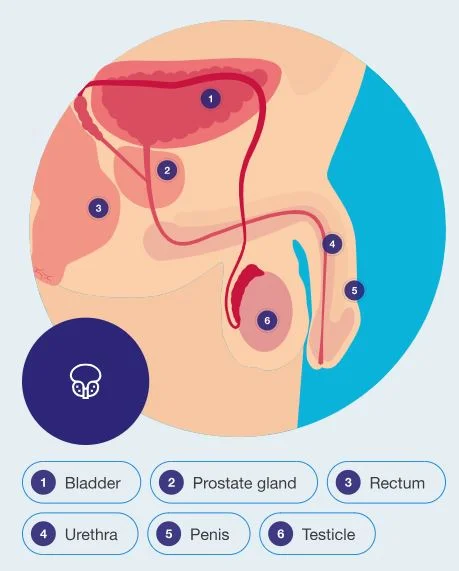
Adapted from Cancer Research UK (2019)¹
Diagnosis of Prostate Cancer
Early prostate cancer typically has no symptoms. Symptoms that may appear as cancer progresses are often caused by the cancer pressing on the urethra, such as increased frequency or difficulty in passing urine.6
A diagnosis of prostate cancer is usually based on the results of clinical examination of the prostate, a blood test to check levels of a protein called prostate-specific antigen (PSA), a magnetic resonance imaging (MRI) scan to decide whether a biopsy is needed.6
Further investigations can help to determine how advanced the cancer is. For example, positron emission tomography (PET)/computed tomography (CT) scans may be used to see how far the cancer has spread and a bone scan can help to detect bone metastases.13
Symptoms of prostate cancer include:2,4-6
- Increased urination especially at night.
- Burning or pain while urinating.
- Trouble holding urine.
- Urgent urination.
- Feeling like the bladder has not emptied fully.
- Difficulty starting to urinate, including straining.
- Erectile dysfunction.
- Blood in the urine or semen.
- Weak, dribbling or interrupted urine flow.
If the prostate cancer has spread to other parts of the body, it can cause other symptoms, such as pain or stiffness in the bones, lower back, hips or pelvis, unintentional weight loss and pain in the testicles.5,6
Your patient should see their doctor if they experience any of the above symptoms. However, it is important to remember that these symptoms can be common in people who do not have prostate cancer and they may also be caused by other conditions. For example, enlargement of the prostate can press on the urethra and, whilst it does not usually develop into cancer can result in similar symptoms to prostate cancer.4

Monitoring and treatment options for Prostate Cancer
Localised Prostate Cancer7
Most localised prostate cancer often grows slowly and might not need treatment and may be able to be monitored with regular check-ups instead. There are some treatment options available which will usually aim to get rid of cancer.
The two ways of monitoring localised prostate cancer are active surveillance or active monitoring where regular tests can be undertaken to check on the progress of the cancer. The aim is to avoid any unnecessary treatment unless these tests show that your patient’s cancer may be growing, or they decide they want treatment in order to delay the side effects of treatment.7
Alternatively, watchful waiting is a way of monitoring prostate cancer that isn’t causing any symptoms or signs of problems. The aim is to keep an eye on the cancer over the long terms and avoid treatment until your patient gets symptoms. By going on watchful waiting, your patient will avoid side effects that may be long-term and will have a huge impact on their overall quality of life.7
Treatment options for localised prostate cancer include:7
- Surgery (radical prostatectomy).
- External Beam radiotherapy.
- High dose-rate brachytherapy – a type of internal radiotherapy.
- Permanent seed brachytherapy – where tiny radioactive seeds are placed in to the patient’s prostate and give a steady dose over radiation over a few months.
Locally advanced Prostate Cancer8
Locally advanced prostate cancer is when the cancer has started to break out of the prostate or has spread to other areas just outside of the prostate. This may have spread into the following areas:8
- Tissue around the prostate.
- The tubes that carry semen also known as the seminal vesicles.
- Body organs nearby such as the back passage or bladder.
- Lymph nodes close to the prostate gland.
The prostate can also become enlarged due to a non-cancerous condition called benign prostate hyperplasia (BPH). This is a normal part of the aging process and is common in patients that are over the age of 50 years. Symptoms for both benign prostate conditions and prostate cancer are similar and can include the following:8
- Needing to pee more often than usual, especially at night.
- Difficulty going to the toilet – for example, a weak flow or having to strain.
- Feeling that the bladder has not been completely emptied.
- An urgent need to pee.
- Blood in urine or semen.
- Pain when peeing or ejaculating which is more rare.
Treatment options for locally advanced prostate cancer are:9
- External beam radiotherapy with hormone therapy (and sometimes with high dose-rate brachytherapy or permanent seed brachytherapy).
- Hormone therapy alone.
- Surgery (radical prostatectomy) often followed by hormone therapy and radiotherapy.
- Watchful waiting.
A smaller number of men may be offered high dose-rate brachytherapy on it’s own but isn’t very common.9
Depending on how far your patient’s cancer has spread, your patient may have a choice of treatments. If so, you will have to talk your patient through the applicable treatment options and help them choose the right treatment for them. Your patient may not be able to have all access to all treatment options listed above.9

Recurrent prostate cancer
Recurrent prostate cancer is when your patient’s cancer comes back after they have had a treatment that aims to cure it. This can sometimes be referred to as prostate cancer recurrence or prostate cancer relapse.10
Treatments for recurrent prostate cancer can include:10
- Surgery (radical prostatectomy).
- External beam radiotherapy.
- Permanent seed brachytherapy.
- High-dose rate brachytherapy.
- Cryotherapy – currently only available at specialist centres in the UK.
- High-intensity focused ultrasound – which used high-frequency ultrasound energy and destroy cancer cells in the prostate.
If your patient has received the news that their prostate cancer has returned, there are number of support options available through one-to-one support services or online communities.10
Non-metastatic castration-resistant prostate cancer
Castration-resistant prostate cancer (CRPC) is a form of advanced prostate cancer. If the prostate cancer diagnosed is CRPC, it means it can grow or spread even with low testosterone levels.11
With Non-Metastatic castration-resistant prostate cancer (nmCRPC), the cancer no longer responds to hormone treatment. It shows signs of growth through a rising prostate specific antigen (PSA) level, but it is only found in the prostate and it has not spread.11
The main goal of treating nmCRPC is to shrink the tumour, control symptoms and slow growth progress. The main treatments for nmCRPC are:11
- Androgen Deprivation Therapy (ADT) also known as hormone therapy treatments. Even if the patient’s prostate cancer shows signs of growth with ADT, it can be used to reduce the spread of the cancer.
- Second-line anti-androgen drugs. These can be used in combination with ADT treatment to stop or reduce the spread of cancer.
- Watchful waiting.
- Clinical trials.

Metastatic prostate cancer
Metastatic prostate cancer or advanced prostate cancer is a cancer that has spread from the prostate to other parts of the body. Treatment won’t cure your patient’s cancer, but it can help keep it under control and manage symptoms.12
Treatment options for metastatic prostate cancer are:12
- Chemotherapy in combination with hormone therapy.
- Hormone therapy alone.
If your patient doesn’t have any symptoms and wants to avoid or delay treatment and its side effects, you may be able to have the cancer monitored with your patients instead through watchful waiting.12 This isn’t usually recommended with watchful waiting as it won’t stop the cancer from growing or spreading. As a healthcare professional, you can help advise on the advantages and disadvantages of watchful waiting.12
The first treatment may help keep your patient’s cancer under control. However, over time the cancer may change, and it may start to grow again. Your patient would normally stay on their first type of hormone therapy as this will still keep the amount of testosterone low in your patient’s body. Consequently, there are other treatment options available to use alongside patient’s first treatment which will help control cancer and manage symptoms. The treatment options can help manage symptoms caused by advanced prostate cancer such as bone pain.12
These might include:12
- More hormone therapy
- More chemotherapy
- Radium-223
- Other targeted medicines for advanced prostate cancer
References:
- Cancer Research UK. 2019. What is prostate cancer? Available from: https://www.cancerresearchuk.org/about-cancer/prostate-cancer/about. Accessed: October 2024.
- Cancer Research UK. 2021. What is hormone therapy for prostate cancer? Available from: https://www.cancerresearchuk.org/aboutcancer/prostate-cancer/treatment/hormone-therapy/about-hormonetherapy. Accessed: October 2024.
- Prostate Cancer Foundation. 2021. Prostate Cancer Patient Guide. Available from: https://res.cloudinary.com/pcf/image/upload/v1651273711/PCF_PatientGuide_Apr2022_negisa.pdf Accessed October 2024.
- National Comprehensive Cancer Network. 2022. Prostate Cancer Early Stage. Available from: https://www.nccn.org/patients/guidelines/content/PDF/prostate-early-patient.pdf. Accessed October 2024.
- Prostate Cancer Foundation. Prostate Cancer Staging. Available from: https://www.pcf.org/about-prostate-cancer/diagnosis-staging-prostate-cancer/prostate-cancer-staging/. Accessed October 2024.
- NHS UK. 2021. Prostate Cancer – Symptoms. Available from: https://www.nhs.uk/ conditions/prostate-cancer/symptoms/. Accessed August 2024.
- Prostate Cancer UK. 2023. Localised prostate cancer. Available from: https://prostatecanceruk.org/prostate-information-and-support/just-diagnosed/localised-prostate-cancer. Accessed October 2024.
- Macmillan Cancer Support. 2021. Locally advanced prostate cancer. Available from: https://www.macmillan.org.uk/cancer-information-and-support/prostate-cancer/locally-advanced-prostate-cancer. Accessed October 2024.
- Prostate Cancer UK. 2023. Locally advanced prostate cancer. Available from: https://prostatecanceruk.org/prostate-information-and-support/just-diagnosed/locally-advanced-prostate-cancer. Accessed October 2024.
- Prostate Cancer UK. 2023. If your prostate cancer comes back. Available from: https://prostatecanceruk.org/prostate-information-and-support/treatments/if-your-prostate-cancer-comes-back. Accessed October 2024.
- Urology Care Foundation. 2020. Non-metastatic castration resistant prostate cancer: What you should know. Available from: https://www.urologyhealth.org/documents/Product-Store/English/nmCRPC-What-You-Should-Know-Fact-Sheet.pdf. Accessed October 2024.
- Prostate Cancer UK. 2023. Advanced prostate cancer. Available from: https://prostatecanceruk.org/prostate-information-and-support/just-diagnosed/advanced-prostate-cancer. Accessed October 2024.
- Prostate Cancer UK. 2022. Scans to see if your cancer has spread. Available from: https://prostatecanceruk.org/prostate-information-and-support/prostate-tests/scans-to-see-if-your-cancer-has-spread. Accessed January 2025.
Related Content

Introducing Orgovyx®
Read more